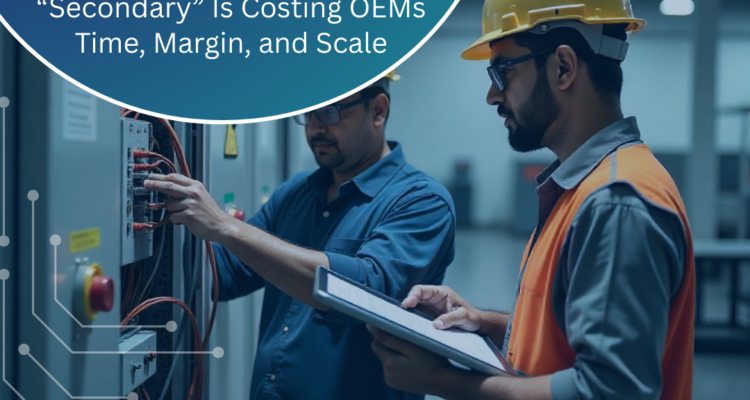
How Poor Electrical Documentation Increases Costs, Inventory Risk, and Delivery Delays for OEMs
OEMs rarely lose business because their machines fail outright. They lose momentum because delivery timelines slip, costs creep up, and repeatability becomes difficult as order volumes grow. In many cases, the root cause is not design capability or supplier quality. It is how electrical manufacturing is positioned internally-often treated as a support activity instead of a production discipline. This mindset quietly impacts cost structures, inventory planning, and dispatch reliability.
Electrical Documentation Is a Manufacturing Control Tool Not a Paper Exercise
Within OEM operations, electrical documentation is often viewed as a compliance or handover requirement. In practice, it is a production control system. When documentation is accurate and locked early, it enables:
Predictable panel manufacturing cycles
Planned procurement instead of excess stocking
Parallel electrical and mechanical production
Dispatch readiness without last-minute corrections
When documentation is weak, manufacturing efficiency drops even if wiring quality is good.
Where Documentation Breaks Down Inside OEM Manufacturing
Documentation failures are rarely caused by lack of engineering skill. They occur due to process sequencing. Common patterns include:
Drawings finalized after wiring starts
Shop-floor changes not reflected in master documents
BOMs and cable schedules updated informally
Engineering teams stretched between design, wiring, and FAT prep
These gaps do not stop production immediately but they quietly introduce cost and delay.
The Hidden Cost of Poor Documentation
Poor documentation does not always create visible defects. Instead, it creates operational inefficiency:
Panels require reopening for verification
Electrical assemblies miss dispatch windows
Extra components are stocked as risk buffers
Engineering time is consumed in clarification loops
Over time, OEMs experience:
Higher WIP inventory
Longer dispatch lead times
Reduced throughput during peak demand
The cost impact compounds with scale.
Why Documentation Issues Worsen as OEMs Grow
As order volumes increase, informal systems stop working. OEMs begin to face:
Dependency on individual engineers’ memory
Inconsistent builds across machine batches
Difficulty standardizing panel designs
Engineering bottlenecks during peak production
The result is not poor quality — it is loss of predictability.
Documentation-First Manufacturing Changes the Outcome
High-performing OEMs treat documentation as part of electrical production, not post-production. This means:
Build-to-print execution from approved drawings
Documentation locked before manufacturing starts
Immediate updates for any controlled change
Panels shipped fully documented and dispatch-ready
This approach reduces:
Rework
Excess inventory
Engineering firefighting
Delivery uncertainty
Where Sai-Lee Fits In
Sai-Lee Electrotekniks supports OEMs through documentation-integrated electrical manufacturing, not site execution.
With over 25 years of experience and CE- and CPRI-certified processes, Sai-Lee helps OEMs:
Manufacture control panels with consistent documentation
Reduce internal engineering load
Align procurement with production schedules
Improve dispatch predictability across orders
Our focus is on cost control, inventory discipline, and on-time delivery through structured electrical execution.
The Real Bottleneck Is Not Engineering - It Is Structure
If machines are technically sound but deliveries feel harder to manage as volumes grow, documentation is often the missing link. Not because it helps at site but because it controls what happens before dispatch. To explore how documentation-first electrical manufacturing can improve cost efficiency and delivery reliability, visit www.sai-lee.in or connect with our team.
Disclaimer
This content is intended for educational and strategic awareness purposes only. It does not constitute legal, financial, or contractual advice. Decisions should be evaluated based on individual organizational requirements.