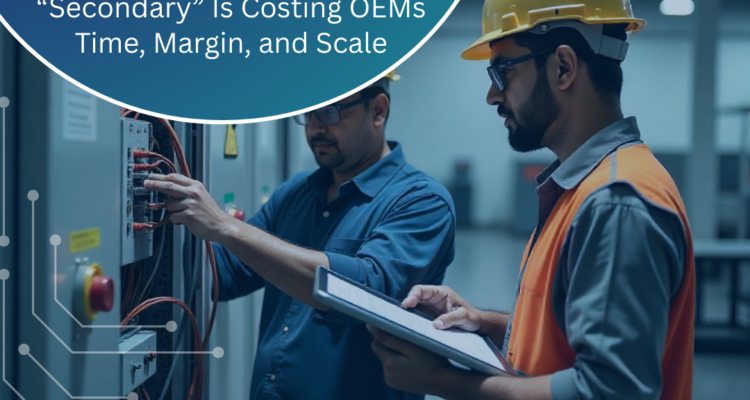
Why Treating Electrical Manufacturing as “Secondary” Is Costing OEMs Time, Margin, and Scale
OEMs rarely lose business because their machines fail outright. They lose momentum because delivery timelines slip, costs creep up, and repeatability becomes difficult as order volumes grow. In many cases, the root cause is not design capability or supplier quality. It is how electrical manufacturing is positioned internally-often treated as a support activity instead of a production discipline. This mindset quietly impacts cost structures, inventory planning, and dispatch reliability.
Electrical Manufacturing Is Often Pushed Down the Priority List
In many OEM environments, mechanical fabrication leads planning decisions, while electrical panels and wiring are scheduled later in the build cycle. This creates structural inefficiencies:
Procurement planning must align with production rhythm
Panels must be available when mechanical assemblies are ready
Inventory must support throughput, not sit idle
Electrical manufacturing is no longer a support function. It is a throughput function.
The Shift High-Performing OEMs Are Making
Sai-Lee Electrotekniks supports OEMs by acting as a structured electrical manufacturing extension, not a site contractor.
With over 25 years of experience and CE- and CPRI-certified facilities, Sai-Lee enables OEMs to:
Manufacture control panels with consistent quality
Reduce in-house electrical workload without losing design ownership
Control inventory through planned, batch-aligned production
Improve delivery reliability across machine orders
Our focus is on manufacturing discipline, documentation alignment, and execution predictability so OEM teams can scale output without scaling stress.
The Real Question for OEMs
If your machines are well-designed but deliveries feel harder to manage as volumes increase, the issue is not capability. It is structure. Electrical manufacturing must support growth, not react to it. To explore how structured electrical manufacturing can improve cost control, inventory planning, and on-time dispatch, visit www.sai-lee.in or connect with our team. Disclaimer This content is intended for educational and strategic awareness purposes only. It does not constitute legal, financial, or contractual advice. Decisions should be evaluated based on individual organizational requirements.